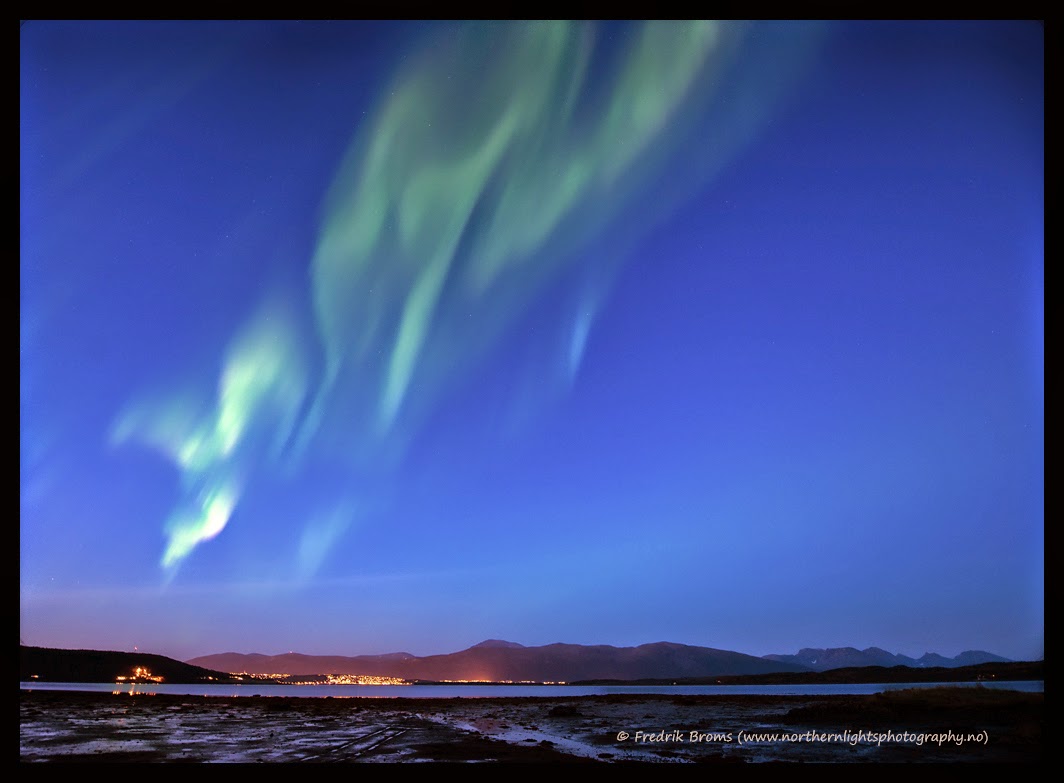
While the blog updates have been suffering lately, I'd like to share this photo from last weekend's research trip celebrating the 100.000 hits on the Northern Lights Photography blog - thanks to everyone who's been visiting and commenting!
All the best from a, right now, windy and rainy Norway!
This blog will post the latest news on northern lights, astronomy and nature-related news from Northern Norway. All photos, videos and text on these webpages are copyrighted. No photos or videos may be downloaded, printed or used in any way without the permission of the copyright holder. If you want to use any of the photos, videos or text, please contact me at info@northernlightsphotography.no
måndag 3 november 2014
onsdag 22 oktober 2014
The Everyday Greyness
Clear skies here in Northern Norway have offered an amazing view of the northern lights lately with the internet buzzing with green photos. However, what caught my own eye lately was rather the grey landscape who covered the area around one of the more scenic fjords around Tromsø, offering a soft and mild tone in the rather special colours of "everyday greyness" - a title I have never given to a photo before.
lördag 20 september 2014
Finally Dark Skies!
With the Moon being only a thin waning crecent right now, the first really dark skies of the season could be glimpsed the other night - it's hard to believe that it's been half a year since last it was possible to see the Milky Way from Tromsø!
I used the opportunity to try and catch a glimpse of the currently brightest comet in the northern hemisphere - comet C/2014 E2 Jacques - a long-period comet discovered in March this year.
Stacking eighteen 30-sec shots showed the comet fairly nicely, even in a "wide-field" image like this, but alas, the comet is fading slowly as it travels from Vulpecula to Aquila during September/October. The magnitude is currently reported to be around 8.0.
Note some of the well-defined dark areas in the lower and left part of the photo - a beautiful area of the Milky Way. Some faint pulsating aurorae was visible all over the sky - finally the dark season is back!
I used the opportunity to try and catch a glimpse of the currently brightest comet in the northern hemisphere - comet C/2014 E2 Jacques - a long-period comet discovered in March this year.
Comet C/2014 E2 Jacques - 16 September 2014
Stacking eighteen 30-sec shots showed the comet fairly nicely, even in a "wide-field" image like this, but alas, the comet is fading slowly as it travels from Vulpecula to Aquila during September/October. The magnitude is currently reported to be around 8.0.
Note some of the well-defined dark areas in the lower and left part of the photo - a beautiful area of the Milky Way. Some faint pulsating aurorae was visible all over the sky - finally the dark season is back!
fredag 29 augusti 2014
First Northern Lights of the Season
Tonight, the Northern Lights finally returned again!
After the long midnight-sun period here in Northern Norway, where it's impossible to see even the brightest stars from end-April - early-August, the autumn always comes as a relief to me when the first stars finally become visible again as the skies gradually get darker for each night.
Last night's aurora display was in fact so strong that, although familiar constellations such as Cassiopeia and the Big Dipper/The Plough are still only to be made out very faintly on the blue night sky, the auroras shimmered and danced in an explosion of colours.
This is what the sky looked like close to midnight just outside Tromsø in Northern Norway.
The aurora-season has begun!
After the long midnight-sun period here in Northern Norway, where it's impossible to see even the brightest stars from end-April - early-August, the autumn always comes as a relief to me when the first stars finally become visible again as the skies gradually get darker for each night.
Last night's aurora display was in fact so strong that, although familiar constellations such as Cassiopeia and the Big Dipper/The Plough are still only to be made out very faintly on the blue night sky, the auroras shimmered and danced in an explosion of colours.
This is what the sky looked like close to midnight just outside Tromsø in Northern Norway.
As Spaceweather report, "the twilight display was sparked by a pair of CME impacts on August 27th. As Earth passed through the wake of the storm clouds, the interplanetary magnetic field (IMF) around Earth tipped south. This opened a crack in our planet's magnetosphere; solar wind poured in to fuel a light show that lasted for nearly three days and nights".
The aurora-season has begun!
söndag 27 juli 2014
Pygmy Owl
Well camouflaged in an old woodpecker nest (probably), this pygmy owl brightened up one of my summer days not long ago here in Troms - perhaps one of the cutest birds ever and the smallest owl in Europe.
tisdag 22 juli 2014
Too warm for a photogapher...
For some reason I photograph very little during summer and therefore the blog updates suffer. Instead, I have been re-designing my website a bit lately and I have added some fresh images of Nordic Wildlife to the galleries. While there is still a lot of work to do I came across some collections of photos that I had almost forgotten about, so here's a July-photo I found in my archive.
lördag 7 juni 2014
Great Snipe in Midnight Sun
Here in Northern Norway, the midnight-sun period is now in full swing and the sun is shining all the night.
Yesterday evening me and a friend went out with our cameras to view the spectacular display of the Great Snipe (Gallinago media) - a near threatened bird - that tradtitionally gathers on leks located on wet mires with tussucks. The strange noise they make, which has been likened to a "ping-pong-match" clould be heard among the tussucks of cloudberries and bog rosemary in the low midnight sun - a beautiful experience and a wonderful bird.
torsdag 5 juni 2014
Photo Exhibition on Baffin Island, Arctic Canada
Last year, my first full-scale international photo exhibition was held in the Canadian capital Ottawa during the three-week long winter-festival "Winterlude".
Later the photo exhibition was displayed in Edmonton, Alberta during the Scandinavian Heritage Fair and now the large panels of the aurora images from Kvaløya, Norway travel all the way to the far north of the Canadian Arctic to Baffin Island and the Nunatta Sunakkutaangit Museum in Iqaluit.
I am proud to have images of Northern Lights on display on Baffin Island and I wish the visitors and organisers all the best from a fellow location in the high north.
Later the photo exhibition was displayed in Edmonton, Alberta during the Scandinavian Heritage Fair and now the large panels of the aurora images from Kvaløya, Norway travel all the way to the far north of the Canadian Arctic to Baffin Island and the Nunatta Sunakkutaangit Museum in Iqaluit.
Aurora Images on Display in Ottawa, Canada
I am proud to have images of Northern Lights on display on Baffin Island and I wish the visitors and organisers all the best from a fellow location in the high north.
måndag 24 februari 2014
Release of New Aurora Documentary - "The Northern Lights - A Magic Experience"
Announcement: The official trailer of the new documentary - "The Northern Lights - A Magic Experience" is now released. Watch the trailer in full HD at Vimeo
Release-info: The 25 minute documentary takes you on a breathtaking journey through space. By using pedagogic top-quality animations and spectacular solar imagery from NASA satellites it tells the full story of the northern lights from myth to science. The film is packed with interesting historical anecdotes and includes tips about how to take your own stunning aurora photos.
It includes some of the world's best photography and time lapse sequences of the northern lights. The film is perfectly suited for use at science museums, planetariums, hotels and by aurora tour guide companies.
The documentary is produced by Pål Brekke, an international recognized solar physicist and public outreach expert with many years at NASA Goddard Space Flight Center (www.solarmax.no/Aurora/Home.html). Co-producer is award-winning aurora photographer and popular science writer Fredrik Broms who took all the aurora images and time lapse footage.
Norwegian and German version of the documentary will soon be released.
Contact one of us for a full preview of the film and for license options.
This is the official trailer of the documentary "The Northern Lights - A Magic Experience"
Release-info: The 25 minute documentary takes you on a breathtaking journey through space. By using pedagogic top-quality animations and spectacular solar imagery from NASA satellites it tells the full story of the northern lights from myth to science. The film is packed with interesting historical anecdotes and includes tips about how to take your own stunning aurora photos.
It includes some of the world's best photography and time lapse sequences of the northern lights. The film is perfectly suited for use at science museums, planetariums, hotels and by aurora tour guide companies.
The documentary is produced by Pål Brekke, an international recognized solar physicist and public outreach expert with many years at NASA Goddard Space Flight Center (www.solarmax.no/Aurora/Home.html). Co-producer is award-winning aurora photographer and popular science writer Fredrik Broms who took all the aurora images and time lapse footage.
Norwegian and German version of the documentary will soon be released.
Contact one of us for a full preview of the film and for license options.
torsdag 23 januari 2014
Orcas and Humpbacks
Still, the North-Norwegian fjords are filled with herring attracting killer whales, humpback whales and fin whales..
söndag 5 januari 2014
Trailer - Aurora Short-Film
The aurora activity is picking up again and below is a short trailer from a longer Northern Lights documentary - The Northern Lights - A Lifetime Experience - special made for the Holmenkollen Ski Museum in Oslo, Norway
For more information, visit the web page of the Ski Museum or see the trailer on Vimeo
fredag 15 november 2013
Humpback Project Start / Knølhval i fokus
Right now, the fishing for herring is in full swing along the coast of Northern Norway. The herring does not, however, only attract fishermen, but also humpback whales and orcas who turn up to feast on the fish.
As a marine biologist, I started up a project in 2010/2011 to collect photos for photo-identification of humpback whales in Norway - a project that has grown enormously since the start and with interesting results starting to emerge about the ecology and migration patterns of humpbacks in Norwegian waters.
This winter I continue my data-collection of fluke-photos for the North Norwegian Humpback Whale Catalogue (NNHWC) as usual, but this year it will also form a part of a larger mulitidisciplinary research project here in Tromsø in Northern Norway with focus on oceanography, fish-stock size estimates using hydroacoustics and testing out of new techniques to monitor this species.
Because no two humpbacks look exactly the same (the flukes have various patterns and markings) the pictures can be used in much the same way as human fingerprints to identify individual whales. If enough pictures from various places are collected over long time, the same individuals may be seen several times and one can start to get an idea of e.g. migration patterns and the population size.
HAVE YOU PHOTOGRAPHED THE FLUKE/TAIL OF A HUMPBACK? PLEASE CONTACT THE NORTH NORWEGIAN HUMPBACK WHALE CATALOGUE (NNHWC) AT: whaleobs@akvaplan.niva.no
Already from the first trip, we were able to identify approximately ten different humpback whales. I will present the scientific results in future posts - this is only be a pure photographic gallery with photos shot from the boat while the hydroacoustician run some test transects showing us dense balls of herring - and the feeding humpbacks were not far away.
As a marine biologist, I started up a project in 2010/2011 to collect photos for photo-identification of humpback whales in Norway - a project that has grown enormously since the start and with interesting results starting to emerge about the ecology and migration patterns of humpbacks in Norwegian waters.
The last Sun of the year? The Polar Darkness period starts 21 November here in Tromsø
This winter I continue my data-collection of fluke-photos for the North Norwegian Humpback Whale Catalogue (NNHWC) as usual, but this year it will also form a part of a larger mulitidisciplinary research project here in Tromsø in Northern Norway with focus on oceanography, fish-stock size estimates using hydroacoustics and testing out of new techniques to monitor this species.
Monitoring pelagic fish at 70kHz and 200kHz
Because no two humpbacks look exactly the same (the flukes have various patterns and markings) the pictures can be used in much the same way as human fingerprints to identify individual whales. If enough pictures from various places are collected over long time, the same individuals may be seen several times and one can start to get an idea of e.g. migration patterns and the population size.
HAVE YOU PHOTOGRAPHED THE FLUKE/TAIL OF A HUMPBACK? PLEASE CONTACT THE NORTH NORWEGIAN HUMPBACK WHALE CATALOGUE (NNHWC) AT: whaleobs@akvaplan.niva.no
Unique humpback fluke - accompaigned by two orcas
Already from the first trip, we were able to identify approximately ten different humpback whales. I will present the scientific results in future posts - this is only be a pure photographic gallery with photos shot from the boat while the hydroacoustician run some test transects showing us dense balls of herring - and the feeding humpbacks were not far away.
söndag 3 november 2013
Comet Galore
Finally a
night with clear skies here in Northern Norway - and an opportunity for some astrophotography!
While comet ISON is getting all the media-attention, the sky is filled with so many more exciting comets right now and on the night between 01 - 02 Nov I set out to see how many different comets I could catch with a DSLR in just one single night.
No less than 5 different comets were visible. While comet ISON is still a huge challenge (at least for me) to see visually, Comet C/2013 R1 Lovejoy and 2P/Encke were easily visible as distinct green fuzzballs in 10x binoculars. Comet C/2012 X1 LINEAR continues its spectacular "17P/Holmes-outburst" and 154P/Brewington was only just detectable as a faint green smudge.
All photos are taken using Nikon D800 and Nikkor 300mm with 1,7 x converter and are stacks of multiple 20-30 sec exposures at ISO 640-1000.
While I enjoyed the comet feast, pulsating aurorae added to the beauty of the night sky.
While comet ISON is getting all the media-attention, the sky is filled with so many more exciting comets right now and on the night between 01 - 02 Nov I set out to see how many different comets I could catch with a DSLR in just one single night.
No less than 5 different comets were visible. While comet ISON is still a huge challenge (at least for me) to see visually, Comet C/2013 R1 Lovejoy and 2P/Encke were easily visible as distinct green fuzzballs in 10x binoculars. Comet C/2012 X1 LINEAR continues its spectacular "17P/Holmes-outburst" and 154P/Brewington was only just detectable as a faint green smudge.
All photos are taken using Nikon D800 and Nikkor 300mm with 1,7 x converter and are stacks of multiple 20-30 sec exposures at ISO 640-1000.
While I enjoyed the comet feast, pulsating aurorae added to the beauty of the night sky.
torsdag 24 oktober 2013
Violent Action on the Sun
With absolutely miserable weather for stargazing up here in Tromsø lately, the sky is finally starting to clear up a bit, and today the Sun - being littered with large sunspots - is shining over the snowclad landscape here in Northern Norway.
While waiting for clear skies to appear also at night-time, I took a quick snapshot of the Sun today from my window sill - a view that is soon about to disappear from these latitudes as we are now approaching the polar darkness period when the Sun doesn't rise above the horizon at all.
Each sunspot is huge - maybe up to 50.000 km in diameter - and the entire Earth would easily fit inside the largest. The middle sunspot (AR1877) recently erupted and produced a solar flare from which strong UV radiation caused a brief HF radio blackout here on Earth today!
To learn more about the Sun and how it affects us - check out todays new book release by my co-author solar phycisist Pål Brekke (in Norwegian)
While waiting for clear skies to appear also at night-time, I took a quick snapshot of the Sun today from my window sill - a view that is soon about to disappear from these latitudes as we are now approaching the polar darkness period when the Sun doesn't rise above the horizon at all.
Each sunspot is huge - maybe up to 50.000 km in diameter - and the entire Earth would easily fit inside the largest. The middle sunspot (AR1877) recently erupted and produced a solar flare from which strong UV radiation caused a brief HF radio blackout here on Earth today!
To learn more about the Sun and how it affects us - check out todays new book release by my co-author solar phycisist Pål Brekke (in Norwegian)
söndag 6 oktober 2013
Bird Photo of the Week / Ukens fuglebilde - 41
Hawk Owl (Surnia ulula) with a recently caught evening-snack-vole on a rainy dark day here in Troms
Northern Hawk Owl (Surnia ulula) / Haukugle
måndag 30 september 2013
Comet C/2012 S1 ISON
Following
the discovery of the 'new' comet, named C/2012 S1 ISON, in September last year, public
expectations of comet ISON have been sky-high, since it has been predicted to
become one of the brightest comets in a long time.
At the time of its discovery by the two Russian amateur astronomers Vitali Nevski and Artyom Novichonok the comet was as faint as magnitude 18.8 and, although it’s now much closer to the Sun, it is still faint (mag 12-14) and impossible to see with the naked eye.
Yesterday morning, however, I managed to catch the comet on a photo using a 300mm lens with a 1.7 x converter, but since ISON is poorly placed low in the sky in a light-polluted part of the sky as seen from my observing spot, the result is poor. Being my first attempt simply to see if I could detect it at all, I didn’t bother with taking any calibration frames and the shot is simply a crude stack combining eight 30-second shots at high ISO.
As always with comets, it is notoriously difficult to predict whether they will put on memorable displays or disappoint and fail to “deliver”, but ISON is expected to reach the naked-eye magnitude 6 in November and, depending on if it survives perihelion passage or not, may be visible to the naked eye until early January 2014.
Let’s hope for another amazing sky show later this winter – at least is was nice to “see” that the comet is on its way as it passed by planet Mars - making it my 24th comet that I have caught with a camera without the use of any telescope. Hopefully it will be possible to catch it without any camera at all later this year - Northern Lights Photography wishes you all clear skies!
At the time of its discovery by the two Russian amateur astronomers Vitali Nevski and Artyom Novichonok the comet was as faint as magnitude 18.8 and, although it’s now much closer to the Sun, it is still faint (mag 12-14) and impossible to see with the naked eye.
Yesterday morning, however, I managed to catch the comet on a photo using a 300mm lens with a 1.7 x converter, but since ISON is poorly placed low in the sky in a light-polluted part of the sky as seen from my observing spot, the result is poor. Being my first attempt simply to see if I could detect it at all, I didn’t bother with taking any calibration frames and the shot is simply a crude stack combining eight 30-second shots at high ISO.
My first 'detection' of comet ISON - 29 Sept 2013
As always with comets, it is notoriously difficult to predict whether they will put on memorable displays or disappoint and fail to “deliver”, but ISON is expected to reach the naked-eye magnitude 6 in November and, depending on if it survives perihelion passage or not, may be visible to the naked eye until early January 2014.
Let’s hope for another amazing sky show later this winter – at least is was nice to “see” that the comet is on its way as it passed by planet Mars - making it my 24th comet that I have caught with a camera without the use of any telescope. Hopefully it will be possible to catch it without any camera at all later this year - Northern Lights Photography wishes you all clear skies!
torsdag 19 september 2013
Astronomy Photographer of the Year 2013
Each year, the
prestigious international photo-competition "Astronomy Photographer of The
Year" is arranged by the Royal Observatory Greenwich, UK and yesterday the
winners of 2013 were announced during an award ceremony in London.
All winning images can be seen at the recent media coverage of the photo-competition by NRK here
"Icy Visitor"
The
competition is divided into three main categories, "Earth and Space",
"Our Solar System" and "Deep Sky", where astro-photographers
around the world compete about the title for the world’s best astronomy photo. Detailed information about the competition can be found here.
This year,
more than 1200 high-quality entries from all around the world entered the competition and I was
therefore very happy and honored to receive both 2nd and 3rd
place in the category “Earth and Space of the competition for my images “Green Energy” and “Icy Visitor”. The first place and overall winner of the competition was Mark Gee from Australia who was awarded first place for his spectacular photo “Guiding Light to the Stars” from New Zealand – congratulations Mark – you are a very worth winner!
“Green Energy”
Out of the
24 finalists, three photographers also got a visit by a film-team from London
that travelled to the places where some of the winning images were captured to
understand the story behind the photos. I was one of the lucky photographers to
receive a visit, and together with the film-crew we returned to the spot where
I took my photos and yesterday Royal Observatory Greenwich released a
short-film on Vimeo telling the tale behind the awarded images (in English):
Fredrik: Sharing the magic of the northern sky
fredag 13 september 2013
Autumn Milky Way
The moon-free nights in September is the perfect time to go out and watch the Milky Way - the combined glow of millions of stars in the disk of our galaxy.
Since the Earth's nightside faces the heart of the galaxy at this time of the year, seeing the Milky Way, arching from east to west in the autumn sky, is truely a sight worth seeing.
måndag 9 september 2013
Bird Photo of the Week / Ukens fuglebilde - 37
Most birds are leaving the high-north now after the breeding season - but not all
In September, a tiny little warbler, no more than 9-10 cm, instead travels a very long distance westwards from the northern Russian taiga and some end up here in Scandinavia. The reason for this long-distance autumn migration is, as far as I know, not understood, but it's a most welcome guest!
And, two days ago, the first of the autumn's yellow-browed warblers was back among the autumn leaves here on Kvaløya again.
In September, a tiny little warbler, no more than 9-10 cm, instead travels a very long distance westwards from the northern Russian taiga and some end up here in Scandinavia. The reason for this long-distance autumn migration is, as far as I know, not understood, but it's a most welcome guest!
And, two days ago, the first of the autumn's yellow-browed warblers was back among the autumn leaves here on Kvaløya again.
Yellow-browed Warbler / Gulbrynsanger / Taigasångare (Phylloscopus inornatus)
tisdag 3 september 2013
Bird Photo of the Week / Ukens fuglebilde - 36
This week's bird-photo portraits one of the smallest and cutest birds that we have in our fauna - the Wren / Gjerdesmett (Troglodytes troglodytes).
The northernmost distribution limit of the species lies here in Troms in Northern Norway, and what was once a familiar species to me when I lived in Sweden, is now a rare sight. A quick and unexpected meeting in the forest two days ago was actually the first time for me to see this otherwise fairly common species up here in the north.
Eurasian Wren / Gjerdesmett (Troglodytes troglodytes)
söndag 1 september 2013
First northern lights of the season + bright nova
After a long summer without any proper nights since April, it has finally started to get dark enough in the evenings to see stars once again and now, on the night between 30-31 August, the first auroras of the season could be seen here in Tromsø, dancing in green and purple over a starry sky.
For the first time it was also possible to get a glimpse of the new "star", being an exciting nova in the constellation Delphinus.
torsdag 29 augusti 2013
Bird Photo of the Week / Ukens fuglebilde - 35
Autumn waders, like here young dunlins and little stints, are gathering in big flocks now before heading south.
Dunlins / Myrsnipe (Calidris alpina) and Little Stints / Dvergsnipe (Calidris minuta)
fredag 23 augusti 2013
Bird Photo of the Week / Ukens fuglebilde - 34
Ooops, I've been really lazy lately and four weeks have passed without any updating of my 'weekly' posts of bird-photos.. The autumn migration is in full swing now and grey, rainy and windy weather rules in Tromsø now.
Northern Hawk Owl / Haukugle (Surnia ulula)
Prenumerera på:
Inlägg (Atom)


.jpg)