Northern Hawk Owl (Surnia ulula) / Haukugle
This blog will post the latest news on northern lights, astronomy and nature-related news from Northern Norway. All photos, videos and text on these webpages are copyrighted. No photos or videos may be downloaded, printed or used in any way without the permission of the copyright holder. If you want to use any of the photos, videos or text, please contact me at info@northernlightsphotography.no
söndag 6 oktober 2013
Bird Photo of the Week / Ukens fuglebilde - 41
Hawk Owl (Surnia ulula) with a recently caught evening-snack-vole on a rainy dark day here in Troms
måndag 30 september 2013
Comet C/2012 S1 ISON
Following
the discovery of the 'new' comet, named C/2012 S1 ISON, in September last year, public
expectations of comet ISON have been sky-high, since it has been predicted to
become one of the brightest comets in a long time.
At the time of its discovery by the two Russian amateur astronomers Vitali Nevski and Artyom Novichonok the comet was as faint as magnitude 18.8 and, although it’s now much closer to the Sun, it is still faint (mag 12-14) and impossible to see with the naked eye.
Yesterday morning, however, I managed to catch the comet on a photo using a 300mm lens with a 1.7 x converter, but since ISON is poorly placed low in the sky in a light-polluted part of the sky as seen from my observing spot, the result is poor. Being my first attempt simply to see if I could detect it at all, I didn’t bother with taking any calibration frames and the shot is simply a crude stack combining eight 30-second shots at high ISO.
As always with comets, it is notoriously difficult to predict whether they will put on memorable displays or disappoint and fail to “deliver”, but ISON is expected to reach the naked-eye magnitude 6 in November and, depending on if it survives perihelion passage or not, may be visible to the naked eye until early January 2014.
Let’s hope for another amazing sky show later this winter – at least is was nice to “see” that the comet is on its way as it passed by planet Mars - making it my 24th comet that I have caught with a camera without the use of any telescope. Hopefully it will be possible to catch it without any camera at all later this year - Northern Lights Photography wishes you all clear skies!
At the time of its discovery by the two Russian amateur astronomers Vitali Nevski and Artyom Novichonok the comet was as faint as magnitude 18.8 and, although it’s now much closer to the Sun, it is still faint (mag 12-14) and impossible to see with the naked eye.
Yesterday morning, however, I managed to catch the comet on a photo using a 300mm lens with a 1.7 x converter, but since ISON is poorly placed low in the sky in a light-polluted part of the sky as seen from my observing spot, the result is poor. Being my first attempt simply to see if I could detect it at all, I didn’t bother with taking any calibration frames and the shot is simply a crude stack combining eight 30-second shots at high ISO.
My first 'detection' of comet ISON - 29 Sept 2013
As always with comets, it is notoriously difficult to predict whether they will put on memorable displays or disappoint and fail to “deliver”, but ISON is expected to reach the naked-eye magnitude 6 in November and, depending on if it survives perihelion passage or not, may be visible to the naked eye until early January 2014.
Let’s hope for another amazing sky show later this winter – at least is was nice to “see” that the comet is on its way as it passed by planet Mars - making it my 24th comet that I have caught with a camera without the use of any telescope. Hopefully it will be possible to catch it without any camera at all later this year - Northern Lights Photography wishes you all clear skies!
torsdag 19 september 2013
Astronomy Photographer of the Year 2013
Each year, the
prestigious international photo-competition "Astronomy Photographer of The
Year" is arranged by the Royal Observatory Greenwich, UK and yesterday the
winners of 2013 were announced during an award ceremony in London.
All winning images can be seen at the recent media coverage of the photo-competition by NRK here
"Icy Visitor"
The
competition is divided into three main categories, "Earth and Space",
"Our Solar System" and "Deep Sky", where astro-photographers
around the world compete about the title for the world’s best astronomy photo. Detailed information about the competition can be found here.
This year,
more than 1200 high-quality entries from all around the world entered the competition and I was
therefore very happy and honored to receive both 2nd and 3rd
place in the category “Earth and Space of the competition for my images “Green Energy” and “Icy Visitor”. The first place and overall winner of the competition was Mark Gee from Australia who was awarded first place for his spectacular photo “Guiding Light to the Stars” from New Zealand – congratulations Mark – you are a very worth winner!
“Green Energy”
Out of the
24 finalists, three photographers also got a visit by a film-team from London
that travelled to the places where some of the winning images were captured to
understand the story behind the photos. I was one of the lucky photographers to
receive a visit, and together with the film-crew we returned to the spot where
I took my photos and yesterday Royal Observatory Greenwich released a
short-film on Vimeo telling the tale behind the awarded images (in English):
Fredrik: Sharing the magic of the northern sky
fredag 13 september 2013
Autumn Milky Way
The moon-free nights in September is the perfect time to go out and watch the Milky Way - the combined glow of millions of stars in the disk of our galaxy.
Since the Earth's nightside faces the heart of the galaxy at this time of the year, seeing the Milky Way, arching from east to west in the autumn sky, is truely a sight worth seeing.
måndag 9 september 2013
Bird Photo of the Week / Ukens fuglebilde - 37
Most birds are leaving the high-north now after the breeding season - but not all
In September, a tiny little warbler, no more than 9-10 cm, instead travels a very long distance westwards from the northern Russian taiga and some end up here in Scandinavia. The reason for this long-distance autumn migration is, as far as I know, not understood, but it's a most welcome guest!
And, two days ago, the first of the autumn's yellow-browed warblers was back among the autumn leaves here on Kvaløya again.
In September, a tiny little warbler, no more than 9-10 cm, instead travels a very long distance westwards from the northern Russian taiga and some end up here in Scandinavia. The reason for this long-distance autumn migration is, as far as I know, not understood, but it's a most welcome guest!
And, two days ago, the first of the autumn's yellow-browed warblers was back among the autumn leaves here on Kvaløya again.
Yellow-browed Warbler / Gulbrynsanger / Taigasångare (Phylloscopus inornatus)
tisdag 3 september 2013
Bird Photo of the Week / Ukens fuglebilde - 36
This week's bird-photo portraits one of the smallest and cutest birds that we have in our fauna - the Wren / Gjerdesmett (Troglodytes troglodytes).
The northernmost distribution limit of the species lies here in Troms in Northern Norway, and what was once a familiar species to me when I lived in Sweden, is now a rare sight. A quick and unexpected meeting in the forest two days ago was actually the first time for me to see this otherwise fairly common species up here in the north.
Eurasian Wren / Gjerdesmett (Troglodytes troglodytes)
söndag 1 september 2013
First northern lights of the season + bright nova
After a long summer without any proper nights since April, it has finally started to get dark enough in the evenings to see stars once again and now, on the night between 30-31 August, the first auroras of the season could be seen here in Tromsø, dancing in green and purple over a starry sky.
For the first time it was also possible to get a glimpse of the new "star", being an exciting nova in the constellation Delphinus.
torsdag 29 augusti 2013
Bird Photo of the Week / Ukens fuglebilde - 35
Autumn waders, like here young dunlins and little stints, are gathering in big flocks now before heading south.
Dunlins / Myrsnipe (Calidris alpina) and Little Stints / Dvergsnipe (Calidris minuta)
fredag 23 augusti 2013
Bird Photo of the Week / Ukens fuglebilde - 34
Ooops, I've been really lazy lately and four weeks have passed without any updating of my 'weekly' posts of bird-photos.. The autumn migration is in full swing now and grey, rainy and windy weather rules in Tromsø now.
Northern Hawk Owl / Haukugle (Surnia ulula)
söndag 28 juli 2013
Bird Photo of the Week / Ukens fuglebilde - 30
Having photographed very little lately, this week's bird photo is a simple species portrait of a Redshank / Rødstilk (Tringa totanus) from the garden - the nr 1 noisiest bird in the area at night!
lördag 20 juli 2013
Bird Photo of the Week / Ukens fuglebilde - 29
This year there are some isolated 'pockets' with high abundance of voles in Northern Norway.
Preferring wet and damp habitats, the Tundra Vole / Fjellmarkmus (Microtus oeconomus) is a highly appreciated food item of various owls hunting in these habitats, and despite an overall low abundance of rodents this year, some birds feeding on voles have managed to raise chicks this summer.
Here is a very charming and fluffy 2-weeks old chick of a Long-Eared Owl / Hornugle (Asio otus) - well fed on a diet of tundra voles.
Preferring wet and damp habitats, the Tundra Vole / Fjellmarkmus (Microtus oeconomus) is a highly appreciated food item of various owls hunting in these habitats, and despite an overall low abundance of rodents this year, some birds feeding on voles have managed to raise chicks this summer.
Here is a very charming and fluffy 2-weeks old chick of a Long-Eared Owl / Hornugle (Asio otus) - well fed on a diet of tundra voles.
söndag 14 juli 2013
tisdag 2 juli 2013
måndag 24 juni 2013
måndag 17 juni 2013
måndag 10 juni 2013
Bird Photo of the Week / Ukens fuglebilde - 24
Red Knot / Polarsnipe (Calidris canutus) resting in Northern Norway before the last leg of the migration to the breeding sites in North-East Greenland.
torsdag 6 juni 2013
söndag 2 juni 2013
lördag 1 juni 2013
Bird Photo of the Week / Ukens fuglebilde - 21
Summer is here and it's about time for me to get the "Bird Picture of the Week" posts up and running again, now that all possibilities for astro-photography is over with the midnight-sun period.
First out is an early-morning portrait of a male Willow Grouse / Lirype (Lagopus lagopus)
tisdag 21 maj 2013
Midnight Sun
Yesterday, the midnight sun period started here in Tromsø and now the Sun won't set until 22 July - more than two months.
While it is far too bright now for any auroras to be seen, and will remain so until the end of August when the skies are getting darker again, the solar surface is far from dull and right now, lots of sunspots cover the solar disc - some of them giving rise to strong solar flares that may effect our technology here on Earth.
The photo below is taken with a DSLR and a Solar Filter fitted on the lens. Never aim your camera or any optical equipment towards the Sun without proper solar filters!
While it is far too bright now for any auroras to be seen, and will remain so until the end of August when the skies are getting darker again, the solar surface is far from dull and right now, lots of sunspots cover the solar disc - some of them giving rise to strong solar flares that may effect our technology here on Earth.
The photo below is taken with a DSLR and a Solar Filter fitted on the lens. Never aim your camera or any optical equipment towards the Sun without proper solar filters!
From now on, the Northern Lights Photography blog takes summer and will focus on wildlife/bird/landscape photography from Northern Norway
onsdag 15 maj 2013
The 4th International Earth & Sky Photo Contest (TWAN)
Yesterday, the results of The 4th International Earth & Sky Photo Contest by TWAN (The World at Night) was announced,
and with over 710 entries from 45 different countries, I am very honored
to be awarded 4th place in the contest with my photo "Solar
Storm".
I wish to congratulate the overall contest winner
Stephane Vetter (France) for his wonderful panoramic photo “Sky Above
Godafoss” in Iceland and all the other winners and photographers. All
winning images and a wide range of photos selected as "Notable" can
be seen in the video on Vimeo or on National Geographic News which showcases many stunning
astrophotos from the contest.
"Solar Storm"
Here
in Northern Norway, the midnight-sun period starts in less than a week (20
May), making night-sky photography impossible until next autumn, so now
over the summer my blog will focus on wildlife and landscape photography, but
seeing so many creative night-sky images from all corners of the world makes
me wish the polar darkness was already on its way back again!
View over the Atlantic Ocean from Northern Norway 1,5 hours before
midnight
Photo taken on 11 May 2013, with only nine days left to the midnight-sun
period
About
TWAN: TWAN is "an international effort to present stunning nightscape
photos and time-lapse videos of the world’s landmarks against celestial
attractions". David Malin, a prominent member of the judging panel and a
world-known pioneer in scientific astrophotography describes this year’s
contest as "The 685 entries the judges examined represent some of the
best TWAN-style photographs ever gathered together in one place. Judging them
was a significant challenge, considering the high standard and variety of the
entries. Given the number of judges and their individual tastes and preferences
and their different ways of working, there was a surprising small spread in the
final selections. The winners are to be congratulated on being outstanding in a
very competitive field, and the entrants commended for presenting us with such
a wonderful variety of inspiring images".
torsdag 11 april 2013
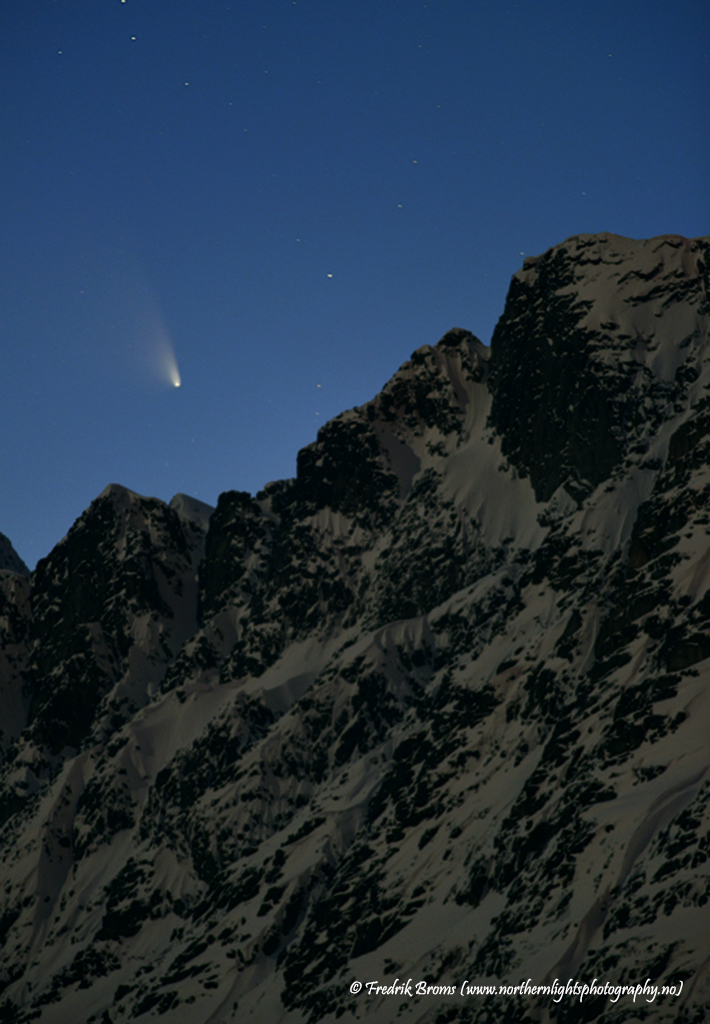
Goodbye Comet PANSTARRS
The northern nights are rapidly getting lighter and lighter for each night now and soon even the brightest stars will be washed out by the light of the Nordic spring.
With an almost constant snowfall for the last 4 weeks here in Tromsø, the chances of seeing the last aurora displays of the season has been slim, but on April 8, there was finally a clear night again and the fading comet PANSTARRS could be seen against a deep-blue sky at midnight and also some auroras could be made out despite low activity.
Only twice since March 20, has there been any chance of seeing the comet, and in a small gap in the clouds on April 4 I managed to get a single 5-second shot as the comet passed by the Andromeda Galaxy.
On April 8, the conditions allowed for a deeper exposure and this 8-minute long exposure reveals the comet's broad dust tail.
With an almost constant snowfall for the last 4 weeks here in Tromsø, the chances of seeing the last aurora displays of the season has been slim, but on April 8, there was finally a clear night again and the fading comet PANSTARRS could be seen against a deep-blue sky at midnight and also some auroras could be made out despite low activity.
Only twice since March 20, has there been any chance of seeing the comet, and in a small gap in the clouds on April 4 I managed to get a single 5-second shot as the comet passed by the Andromeda Galaxy.
Comet PANSTARRS (right) and the Andromeda Galaxy (left)
On April 8, the conditions allowed for a deeper exposure and this 8-minute long exposure reveals the comet's broad dust tail.
Comet PANSTARRS broad dust tail
måndag 25 mars 2013
Comet Timelapse
Early in the evening on March 20, when the bright comet Pan-STARRS came out from the twilight, I decided to make a timelapse, using a 200mm and a 300mm telephoto lens, as the comet was setting behind the mountains.
Up here in Tromsø, the weather continues to block out the night-sky, and it was only on March 20-21 that the sky cleared up, but when it did - it revealed an amazing show.
The comet is now climbing higher and higher up in the sky for each night and, if the weather co-operates, it is now circumpolar and possible to see all the time, provided it is dark enough.
As the comet is leaving the inner solar system, it also fades in brightness, so now is the time to grap the chance of seeing this icy visitor before it's too late - next time it returns to the inner solar system is not until approximately 110 000 years.
onsdag 20 mars 2013
Comet + Auroras
Tonight a dream that I have had for a very long time has come
true - seeing a bright comet and auroras together in the night sky.
First comet Pan-STARRS set behind the mountains at the locality I was shooting at just 5 minutes before the auroras turned up, but driving to another locality with a clear view to the north-western horizon revealed a sight that I will never forget! Pan-STARRS was now even easily visible to the naked eye and a truely wonderful sight.
tisdag 19 mars 2013
Comet Panstarrs - Finally a gap in the clouds !
After a difficult and long waiting-period, with amazing photos from all over the world buzzing in the media, I finally got to see comet C/2011 L4 Panstarrs this evening!
The sky over Tromsø here in Northern Norway has been covered in clouds and snow ever since the comet became theoretically visible here in the northern hemisphere, but tonight, a small, but sufficient gap in the cloud-cover revealed the beautiful comet for a while before the clouds rolled in again.
Not much time for composing the image when the clouds finally revealed it, a bit higher up then I had expected, but a few quick snap-shots with a 300mm lens captured the comet nicely. I was surprised it was so bright that it was even possible to see it with the naked eye!
fredag 15 mars 2013
Freckles on the Sun
This morning started with sunshine, and with a solar face so full of freckles, spring can't be far away now...
torsdag 14 mars 2013
Comet C/2011 L4 PANSTARRS
Having graced the skies in the southern hemisphere for a while, the bright comet C/2011 L4 PANSTARRS has now passed perihelion - its closest approach to the Sun - and the first positive sightings have been reported from northern Europe as the comet recently swung into the skies of the northern hemisphere.
I tried to see the comet yesterday evening, which was probably the first chance to catch a glimpse of it here from Tromsø in Northern Norway, but less than an hour before sunset the clouds rolled in and covered all the western horizon, blocking the comet from view.
Right now, while bright, the comet is still fairly close to the Sun and may be difficult to spot simply because it is seen against such a bright background twilight sky, but for each day now the comet will become increasingly easy to spot (at least if the weather co-operates...) since it will be seen against a darker sky for each night as it travels away from the Sun.
At the same time, however, its brightness is predicted to drop (unless it catches us by surprise as comets have a tendency to do), but the following weeks/s should nevertheless offer a nice evening view of this icy wanderer as it climbs higher and higher up in the sky and if not a naked-eye object it should be an easy target in a pair of binoculars.
Right now, to find the comet, look for it fairly low due west after sunset. For more details on where to locate the comet, consult Skyhounds excellent finder charts here. In appearance, it should look something like the famous comet C/2006 P1 McNaught (photo below), but not as bright as McNaught was.
I tried to see the comet yesterday evening, which was probably the first chance to catch a glimpse of it here from Tromsø in Northern Norway, but less than an hour before sunset the clouds rolled in and covered all the western horizon, blocking the comet from view.
Right now, while bright, the comet is still fairly close to the Sun and may be difficult to spot simply because it is seen against such a bright background twilight sky, but for each day now the comet will become increasingly easy to spot (at least if the weather co-operates...) since it will be seen against a darker sky for each night as it travels away from the Sun.
At the same time, however, its brightness is predicted to drop (unless it catches us by surprise as comets have a tendency to do), but the following weeks/s should nevertheless offer a nice evening view of this icy wanderer as it climbs higher and higher up in the sky and if not a naked-eye object it should be an easy target in a pair of binoculars.
Right now, to find the comet, look for it fairly low due west after sunset. For more details on where to locate the comet, consult Skyhounds excellent finder charts here. In appearance, it should look something like the famous comet C/2006 P1 McNaught (photo below), but not as bright as McNaught was.
Comet PANSTARRS should look something like the famous Comet C/2006 P1 McNaught
(but it is not as bright as McNaught was) as seen here on a photo from Tromsø, 8 January 2007
Happy comet hunting!
måndag 25 februari 2013
Looking back on Humpbacks
Earlier in the winter, the overwintering herring has provided some of the largest marine predators with a "Smörgåsbord" here in Northern Norway.
By now, the herring has moved further south on its spawning migration, but three months ago my friend and colleague Audun Rikardsen and me went out to document the spectacular feast together with the film crew of "Ut i Naturen" that can be seen tomorrow (26 Feb) here.
The first humpbacks we saw on the trip were feeding together in Skulsfjorden outside Tromsø in the last rays of the sun before the polar darkness period that begun the day after our trip (21 Nov 2012).
By now, the herring has moved further south on its spawning migration, but three months ago my friend and colleague Audun Rikardsen and me went out to document the spectacular feast together with the film crew of "Ut i Naturen" that can be seen tomorrow (26 Feb) here.
The first humpbacks we saw on the trip were feeding together in Skulsfjorden outside Tromsø in the last rays of the sun before the polar darkness period that begun the day after our trip (21 Nov 2012).
torsdag 14 februari 2013
fredag 1 februari 2013
Aurora Photo Exhibition - Winterlude, Canada
Today, the
Sun is shining on newly fallen snow on the mountains around Tromsø in Northern
Norway - a wonderful, and longed-for sight after the long period of polar darkness. A perfect time to celebrate the beauty of the winter!
Part of the Exhibition: “Northern Lights; Nature’s Own Magical Lantern"
Presented by the Royal Norwegian Embassy, Ottawa, Canada
In Canada, they have understood this perhaps better than in any other place. Today, 01 February, the three-week long festival - "Winterlude" - that celebrates the winter starts and on the programme is musical concerts, skating displays, ice-sculpture competitions and much more.
In Confederation Park in Ottawa (also known as Crystal Garden, being the site for the ice sculpture competition), my photo-exhibition “Northern Lights; Nature’s Own Magical Lantern” will be on display daily during the festival. The exhibition is presented by the Royal Norwegian Embassy together with the National Capital Commission (NCC) in Canada.
I wish the amazing organisers of Winterlude in Ottawa, Canada all the best luck with the weather and the festival - few things are more beautiful than ice, winter and a dark clear sky with northern lights!
Prenumerera på:
Inlägg (Atom)


.jpg)
.jpg)


.jpg)


.jpg)
.jpg)


.jpg)