tisdag 8 maj 2012

Snow Buntings and Snow Huntings

One of the nicest signs-of-spring here in Tromsø in Northern Norway is when the large flocks of Snow Buntings (Plectrophenax nivalis) arrive. To me, they always make me think of some kind of large black-and-white butterflies when they fly around, and their beautiful and rather mournful song stir up many memories from when I lived on Svalbard up in the north. In short, it`s one of my favourite birds.


Snow Bunting - male


After having spent the winter in Russia and adjacent areas, the Snow Buntings migrate north-east in the spring and stop here in Northern Norway before they continue on their long journey to the breeding areas in Eastern Greenland. The coasts of Northern Norway is the last chance for them to refill their body-reserves before undertaking the long flight across the Atlantic, and many of them double their weight before they continue their journey.


Snow Buntings coming in for landing on a grassland patch


The first Snow Buntings usually arrive here in the end of March, but the large flocks arrive somewhat later in April and mix with the local breeding birds. In some years, they pass by the area almost unnoticed, mostly high up in the mountains, but in years with heavy snow-fall in the spring (like this year), they may be seen foraging in large flocks along the coasts and mud-flats and even in the middle of Tromsø city center.


Early in spring, the flocks are dominated by males. The females usually arrive a bit later.


This year, the snow is still falling even though it`s soon mid-May. Other birds, with similar migration patterns and breeding habitats, have also turned up in the large flocks now, and during the last couple of days Lapland Buntings (Calcarius lapponicus) have arrived within the Snow Bunting flocks. During a weekend trip, I spent some time with the birds with my camera in the rather chilly summer weather of Troms.


Two Snow Buntings together with a Lapland Bunting
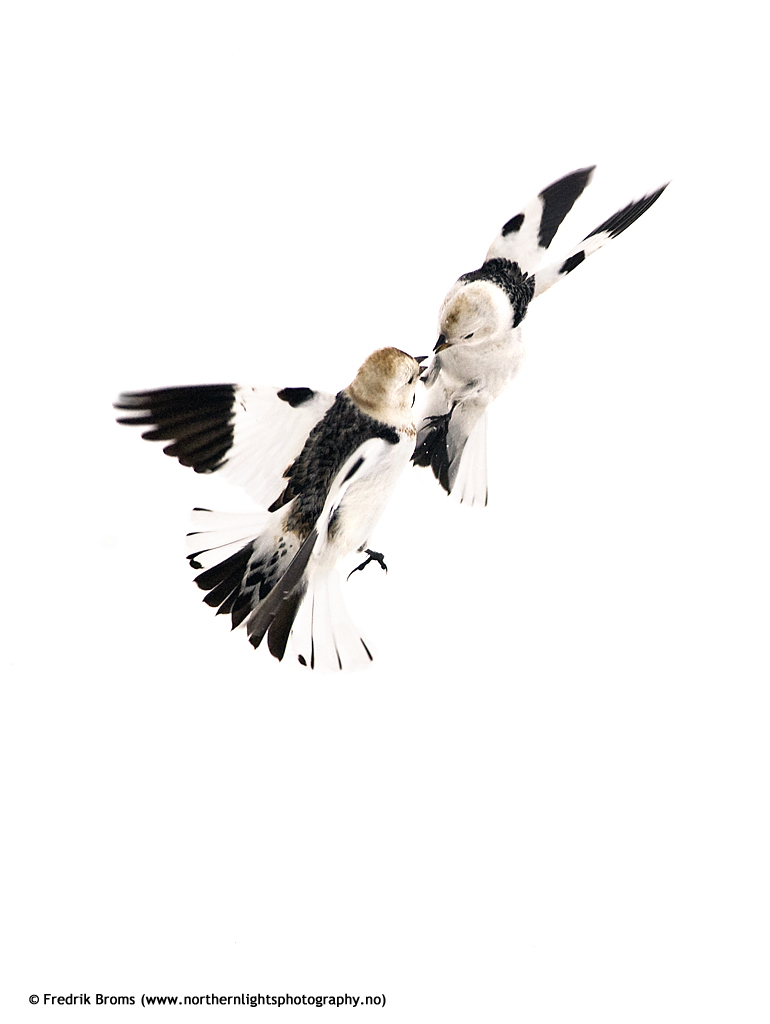


Two males fighting on top of the snow. The background has been burned out.


The arrival of the Snow Buntings attracts various birds of prey that don`t say no to a well-fed bird. While photographing a flock in the snowfall this Sunday, one of the most formidable hunter of small birds, the Sparrow Hawk (Accipiter nisus), suddenly appeared in the middle of the flock and grabbed a snow bunting for lunch.


With relatively strong winds from the East, it is probably just a matter of days before the majority of them leave now, but soon another nice spring-migrant, the Red Knot (Calidris canutus), is here again, replacing the black and white flocks with flocks of red...

tisdag 24 april 2012

Great Grey Owl / Lappugle

After the first time I saw a Great Grey Owl (Strix nebulosa) in Northern Sweden many years ago, I have always wanted to spend more time with this majestetic big owl of the Northern Forests. This spring, there has been many reports of the great grey from many places over Scandinavia, and finally, I was able to stand eye to eye with the king of the forest again.

I spent too little time in the forests to be able to tell a story about the owls, but most of the daytime was spent resting, and few or no attempts to catch voles was seen during mid-day. In early morning and in the evenings, they started to get more active and with ever-lasting patience, their special hunting-technique often gave result. The food was always eaten directly after capture.


Resting during daytime


Great Grey Owl - Landscape


Early morning


As the evening drew closer, the owls started to get more active and after much waiting suddenly an owl would take off after hearing something under the deep snow. After locating the sound of a vole under the snow-cover, she (or he) hit the snow with amazing precision using the long legs to get down to the vole - a hunting technique that will never stop fascinating me.

Seconds after taking off, the owl often hovered in the air for a fraction of a second for some final fine-tuning, and then dived towards the invisible target under the snow with determination.


This time, the owl didn`t manage to catch anything and soon flew away again to start listening again. With the crust on top of the snow being hard, the hunting got more and more difficult and this is probably one of the reasons why so many great grey owls have been reported in areas far south of their "normal" range of distribution.

Portrait - Great Grey Owl


Off hunting in the evening...

torsdag 12 april 2012

Snowy Owl / Snøugle

Seeing a Snowy Owl (Bubo scandiacus) once in life is a dream for many people, and as a keen biologist, I have always shared that dream. When I moved to the high north of Scandinavia, I knew that I at least had the theoretical chance of seeing the species, but despite a historical good breeding year in 2011, I never managed to see the owl. (I do, however, have a pretty good overview of most of the white stones and owl-shaped lumps of snow in the surroundings... : - )

A fairly stationary young female owl in Lapland offered my first meeting with the great white owl, and even though I had hoped to discover one in the mountains close to where I live, I was not disappointed. What a beauty!


During the first day with the owl, she was sitting motionless during pretty much the entire day and showed no signs of hunting, neither in the morning, nor in the evening. The only activity was some occasional cleaning of her plumage or some yawning and stretching. Some locals that we met talked about seeing her feeding on a mountain hare (Lepus timidus) the day before, so maybe she was content and well-fed and was enjoying some rest in the sun.


In the evening, the owl started to get more active. However, the weather during the last days (with really warm days and bitter cold nights), had created an almost impenetrable crust of ice (skare) on top of the snow, making it very difficult for the owl to reach through, and the first hunting attempt was unsuccessful.


Stretching the wings in the evening light


In the afternoon of the second day, the owl successfully caught two voles, both within 40 minutes. With the hard snow cover, I was impressed by this, and it really made me wonder how on earth she could possibly locate and catch the food. Not until I started to look at the pictures during post-processing did I get a more clear idea of the special hunting strategy. The owl saw something I didn`t - which is hardly surprising, but it almost slipped my eyes even when I had it in front of me.

The first successful hunt I saw, happened at quite some distance and the sequence below is composed of 5 hand-held shots with a 300mm lens, showing the owl coming in from the right and chasing a vole that is running on top of the snow to the left, and finally grabbing it in the claws. Why did the vole go up on the snow in the first place? I thought that maybe they simply come up every now and then if the tunnels under the snow are not good enough, and didn`t think much more abount it.

In the sequence below, the reason why the vole had come up on the snow became evident (even though it is hard to see from the pictures taken at such big distance). The little pole/stick to the right in the photos (that I used to center the individual frames) suddenly dissapeared when I was centering the last frame, and that`s when I discovered that it was a weasel (Mustela nivalis) or a stoat/ermine (Mustela erminea).

Probably the weasel had been hunting the vole under the snow, and the vole, trying to escape, came up on the snow, only to find another predator - a hunting owl. Life is hard when you`re a vole! In the last shot of the sequence the weasel returns back in the tunnel under the snow.


The photo must be viewed in large size so see this - the photo below is a 3000x2345 pixels version.


Snowy Owl hunting sequence:
A vole is being scared up to the surface of the snow by a weasel. The vole is then
elegantly caught by the owl while the weasel had to start hunting for another prey.


Snowy Owl - White-Out


As the evening came once again, it was time to say goodbye to the owl, and after a day with much overcast weather, the clouds started to slowly drift apart and the waxing moon came out. As the moon shone over the snow-covered landscape, the owl was once again sitting in a nearby tree searching for any signs of food - a very difficult view to leave, but a meeting full of memories.


Late evening

tisdag 10 april 2012

Ice Halo

Among the various optical phenomena, the common rainbow is probably the most well known.

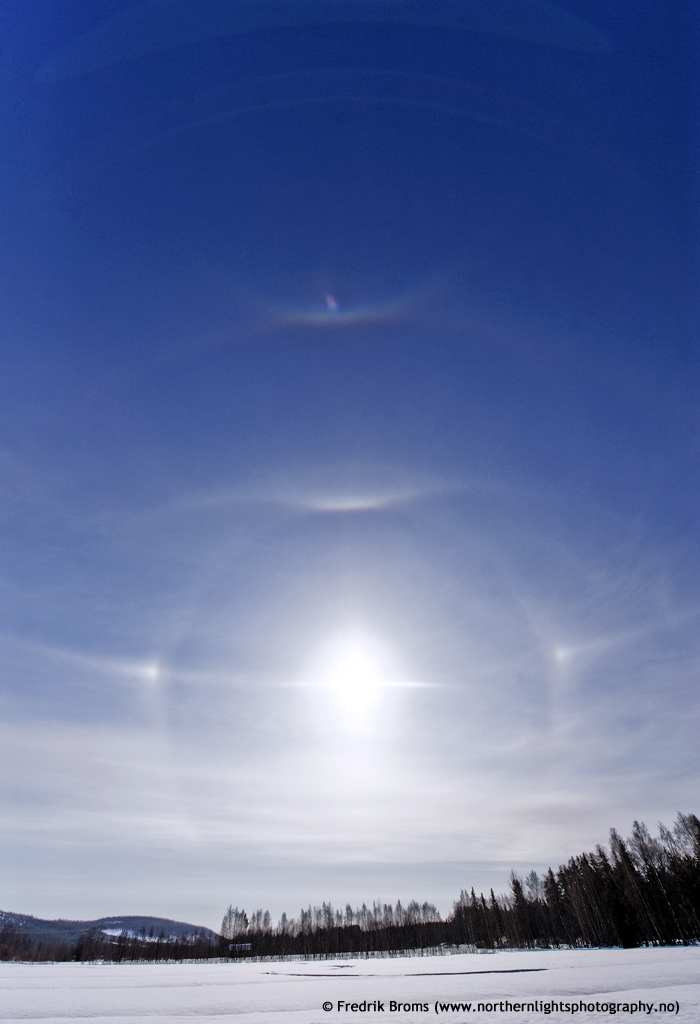
Less known, but occurring more frequently, are the various types of ice halos around the sun (or the moon), and now during late winter/early spring halos can be seen rather often (but take care not to look at the sun!).

The various shapes of ice crystals in the upper troposhere can produce many different types of ice halos including coloured or white arcs and spots and below is a picture of the most frequent ones, observed a couple of days ago.


Several different types can be seen in the picture and below is the same version of the picture with labels of the names of the different halos.


söndag 1 april 2012

Still some beautiful nights left..

The nights above the Arctic circle are rapidly getting lighter and lighter, and soon only the very brightest stars can be seen.

There are, however, still some beautiful nights left and even some auroras have been visible lately, before the night-photography season is over for this time and the midnight sun period will take over.

Below is a photo of the Moon and Venus shining over a silent fjord in Northern Norway. Some rather dramatic clouds heralding a change in weather is adding that little extra bit of drama to the otherwise silent landscape.


Norwegian Fjord with Moon and Venus

tisdag 27 mars 2012

Crossbills - (Korsnebber)

The season for northern lights is inevitably coming to an end even if there might still be a chance to see the auroras for a couple of more weeks. Despite high solar activity lately, most parts of Northern Norway have experienced lots of grey and cloudy weather, and only occasionally the green glow of the aurora has been possible to glimpse through the thick cloud-cover.

The nights are getting light quickly now and the spring is marching in with new signs of spring coming almost each day. Birds arrive again from the south to their breeding areas in the north and without the dark skies "Northern Lights Photography" will focus more and more on the Scandinavian wildlife until the next season in September-October - in the year of solar maximum!

First out are some of the early breeders among birds up here - the crossbills. All over Scandinavia, the Two-barred crossbills (Loxia leucoptera) have occurred in higher than usual numbers after an invasion from the north-east (Russia) last year, and in many places they are still around feeding on their favourite food - cones of larch.


Two-barred crossbills (Loxia leucoptera) feeding on larch


Two-barred crossbill (Loxia leucoptera) - male


Two-barred crossbill (Loxia leucoptera) - male


The unusual shape of the bill - giving them the name crossbills - is an adaptation to assist in the extraction of the seeds from the cones as can be seen on the short video-clip of common crossbills (Loxia curvirostra) below:


Common crossbill (Loxia curvirostra) feeding on cones in Tromsø

måndag 6 februari 2012

Cold is beautiful

The last week has been really cold, and in my eyes, the colder, the more beautiful the world usually gets. A warm summers day can be fantastic, and I really look forward to the northern spring, but nothing ever beats the frozen silent winter-world.


The last rays of sun on the mountain "Piggtinden" stretching 1505 m over the sea. 


A Northern Hawk Owl is watching over the winter landscape in front of the Moon


Cold is beautiful


fredag 27 januari 2012

Comet in the morning sky

Comet Garradd has been visible in the sky for a long while now. During the first part of the winter, the comet was best seen in the evenings, but it has dropped lower for each day and is now best viewed in the mornings.

The comet is located in the constellation of Hercules and can be found reasonably high in the skies in the early morning hours. The comet is fairly bright, but unfortunately just below naked-eye visibility. It is, however, an easy binocular target and can be seen with a normal pair of binoculars (say 8x45) even from moderately light-polluted skies.

Below is a picture of the comet taken in the morning of 26 January 2012 with a DSLR and a 300mm lens (consisting of ~50 stacked 30-second exposures). The comet is sporting two tails and the photo below reveals the ion tail of the comet (which can be seen extending to the right of the green coma) and the dust tail (stretching down below the comet). Earlier in the year, the two tails appeared like single tail as seen from our perspective, but as the comet rounded the Sun, the two tails can now be seen separately.

The green glow in the background is due to faint pulsating auroras in the sky.

Comet Garradd will remain visible in the constellation of Hercules for yet a long time.


Comet C/2009 P1 Garradd

torsdag 26 januari 2012

Crescent Moon + Venus (and Uranus)

Tonight, the crescent Moon (12% lit) and the planet Venus (shining brightly at mag -4) can be seen closely together in the sky as the sun sets.

This is the pair together last evening (25 January). Tonight, they will be even closer to eachother.


Tonight (26 January 2012) the pair looks like on the picture below. Note that it is not only possible to see the Moon and Venus close to eachother. A little further up the blue dot of Uranus can be seen and a little further to the west (not on the picture) Jupiter shines almost as bright as Venus. A night for planet-watching!


tisdag 24 januari 2012

Update - Solar Storm in Progress

During the last three days, very strong northern lights have been seen all around the Arctic circle.

As predicted, a strong coronal mass ejection (CME) hit the Earth`s magnetic field only an hour ago at approximately 1500 UT, as reported by my colleague Rob Stamnes at Polar Light Center in Lofoten, Norway.

This means that strong auroras are very likely in the hours ahead, so if you have clear skies, go out and have a look at the night sky!

Below is a video sequence I made from the solar storm of 21-23 January 2012 - tonight`s show might be even better!


The Sun is awake!

Last Saturday (Jan 21) was the return-of-the-Sun day here in Tromsø, when the Sun could be seen above the horizon for the first time since November last year. Because of mountains blocking the view I haven`t seen the actual Sun yet, but the reflected light could be seen on the mountain slopes and soon it will reach even higher.

The Sun, however, did much more than "just" return this weekend - it also sent along a so-called coronal mass ejection (CME), which hit the Earth's magnetic field and produced some very strong northern lights all around the Arctic circle.

This is what the night sky looked like as seen from Kvaløya outside Tromsø. The pictures are from January 21, 22 and 23rd.


Auroras and the planet Jupiter in the gap of Ersfjorden, Norway


The Pleiades and Jupiter framed by auroras and the mountains of Kvaløya


Northern Lights corona in green and red


Red auroras


View from the outside of Kvaløya on January 22

tisdag 10 januari 2012

Humpback Whales in Polar Darkness

Yesterday was an amazingly beautiful winter day here on Kvaløya on the coast of Northern Norway.

I woke up in the morning to the blue light of dawn and felt that the temperature in the bedroom was around 7-8 degrees. What this usually means is that the sky has been clear during the night, allowing the temperature to drop both outside and inside, and when I looked out, the brighter stars were still sparkling like little gems over the snowclad landscape and the sky was crisp and clear.

It is still polar darkness here in the north, so the Sun doesn`t rise above the horizon until the end of the month, but the special light can make January one of the most beautiful months of the year.

What can then possibly be better than going out at sea and watch the mountain-peaks of the fjords rise like snow-giants out of the sea in the blue morning light? I was lucky enough to be invited out for a boat trip by another biologist and photographer (thank you so very much for an amazing trip Audun - it is a true pleasure to be out with such nice persons as you guys and great to meet people with similar interests).


Gulls feeding on herring around mid-day outside Kvaløya


After searching along the coast for any signs of humpback whales for the identification project - Humpback Whale ID - we couldn`t find any whales in the areas where they had been spotted earlier, but outside the characteristic mountain "Håja", we saw thousands of gulls and drove towards them. When we came closer, we saw the blows of two humpback whales feeding on herring, together with lots of gulls, razorbills, and no less than 16 sea eagles, that wanted to have their share of the food.


Humpback Whale in Polar Darkness


The short days only allowed for a few pictures before the dusk came, but we stayed out at sea as long as possible to enjoy the afternoon light and to see the Moon rise over the horizon. When Venus and Jupiter were climbing above the mountains, and more and more stars became visible in the sky, we headed back home as darkness fell once again over Kvaløya.


Full Moon rising next to Sandøya


Full Moon over Sandøya as seen from open sea


Humpback Whale in the dark


Dusk over Senja

söndag 1 januari 2012

The best fireworks of New Year

Happy New Aurora Year!

Last year ended with a wonderful northern lights show, and as midnight drew nearer, the sky was painted in green and the stars shone like little gems in the cold winter night.

On a night like this, when the sky is filled with it`s own fireworks, I have to say I can`t really see the point in sending up a bunch of rockets in the sky that goes bang and leaves behind a lot of chemicals. I know I may sound a bit boring, and lets face it, it only happens once a year, but admittedly, I have never been a huge fan of fireworks, and even less so when the sky is putting up a show of its own in green and purple with more amazing patterns than any pyrotechnical engineer can ever dream about !


I hope 2012 will offer many more displays like this - full of amazing colours and patterns - and completely silent and free for everyone to watch.

I wish you all clear skies and the very best for the coming year - which is probably going to be a good year for auroras with the solar maximum coming up in 2012/2013.

Below is a small time-lapse teaser of the northern lights from the last day of 2011: